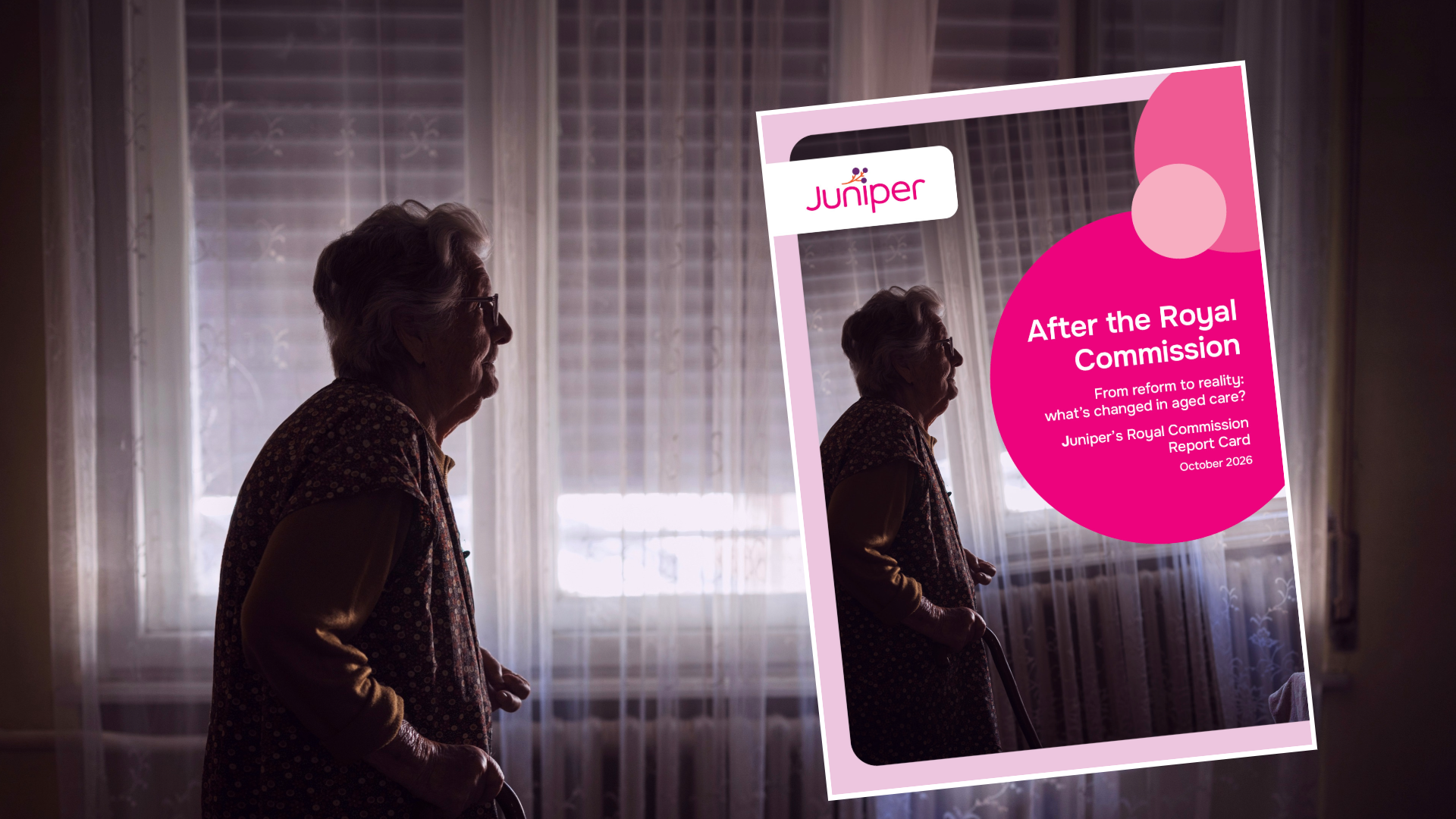
Eight years after the Royal Commission into Aged Care Quality and Safety was established – and more than five years after it delivered its landmark final report, exposing a system in crisis – too many older Australians are still waiting for the meaningful change they were promised, according to a new report by Juniper.
Released on the eighth anniversary of the establishment of the Royal Commission on 8 October 2018, and ahead of the first anniversary of the new Aged Care Act, Juniper’s Royal Commission Report Card has assessed whether reform is in fact delivering better outcomes for older Australians.
While significant reforms have been introduced, including the new Aged Care Act on 1 November, Juniper has awarded the Government an overall grade of C-, finding the changes have not yet translated into meaningful improvements for many older Australians.
Juniper CEO Russell Bricknell said the findings raise an uncomfortable but urgent question about the impact of aged care reform.
“There has been a huge amount of change across our sector since the Royal Commission, and there are reforms we should acknowledge as important steps forward,” Mr Bricknell said.
“But eight years on, we really need to start looking beyond legislation and policy announcements and ask a very simple question: are older people getting the care and support they need when they need it? For far too many older Australians, the answer is still no.”
Juniper’s Royal Commission Report Card examines whether aged care reforms are delivering the outcomes the Royal Commission envisaged, with a focus on rights-based care, support at home, residential aged care, the workforce, dementia care, First Nations communities, diversity and inclusion, and regulation and accountability.
Findings are drawn from publicly available data, government reports, independent reviews, inquiry submissions and sector research, along with the lived experiences of Juniper staff, customers and their families.
Grades were assigned based on the extent to which reforms are improving outcomes for older Australians, ranging from strong evidence of meaningful improvement, to areas where progress has been made but important gaps remain, areas showing limited and uneven progress, and areas where there is little evidence of real-world improvement.
The introduction of the new Aged Care Act marked a significant shift towards a more rights-based aged care system. For the first time, older Australians have a clear Statement of Rights that puts dignity, choice and independence at the centre of care. The Act is backed by stronger Quality Standards, a new Code of Conduct, improved complaints processes and greater accountability for providers.
However, despite the volume of reform activity, many of the transformational changes envisioned in the Royal Commission’s final report Care, Dignity and Respect have yet to reach the lives of older Australians – and some reforms risk doing more harm than good.
Juniper’s Royal Commission Report Card found:
- Rights-based reform has not been fully embedded, especially the obligation on the Government to uphold the rights of the older person.
- Despite being promoted as a consumer-directed model, aspects of the Support at Home program have reduced rather than enhanced consumer choice.
- Demand-driven access to aged care, a key aspiration of the Royal Commission, has not been achieved with around 200,000 older Australians either waiting to be assessed or receive Support at Home.
- The supply of residential aged care places is also falling behind demand with current funding settings making new facilities more difficult to build.
- Recruitment and retention remain major challenges, particularly in regional and remote areas.
Mr Bricknell said the findings of the report suggest the Government has focused heavily on implementing reforms but not paid enough attention to whether those reforms are delivering the outcomes older Australians were promised.
“The Royal Commission called for an aged care system where older people could live with dignity, choice, independence and connection. Those outcomes need to be the measure of whether reform is working,” Mr Bricknell said.
“The Government has delivered structural reform, but it has not yet demonstrated that those reforms are translating into better outcomes for older Australians.”
Juniper’s Royal Commission Report Card identifies continuing challenges across multiple areas, including workforce challenges, culturally appropriate services for First Nations older people and affordability barriers within the new Support at Home program.
It also warns that reforms designed to improve rights and choice risk being undermined if older Australians are unable to access care in a timely manner or cannot afford the services they need.
Mr Bricknell said the next stage of reform must focus less on implementation and more on outcomes.
“We need to make sure the system works for the people it was designed for. That means timely access to care, genuine choice and control, sustainable services in regional and remote communities and workforce with the capacity to meet growing demand,” he said.
“The Royal Commission gave Australia a roadmap for change, we just need to make sure we’re actually getting to the right destination.”
Mr Bricknell added that while the pace of progress has been frustrating, Juniper remains committed to working collaboratively with all levels of governments and sector partners to ensure reforms translate into meaningful change for Australians following the Royal Commission.
Read Juniper’s Royal Commission Report Card here.

 Contact
 1300 313 000